In late 2024, I originated the vision for an AI-native platform home and turned the next chapter of our interoperability work into the company's top strategic initiative, spanning eight business units and more than 40 scrum teams.
ServiceNow · 2024–2025 · Originated the vision, authored the principles and concepts, facilitated the cross-BU workshops
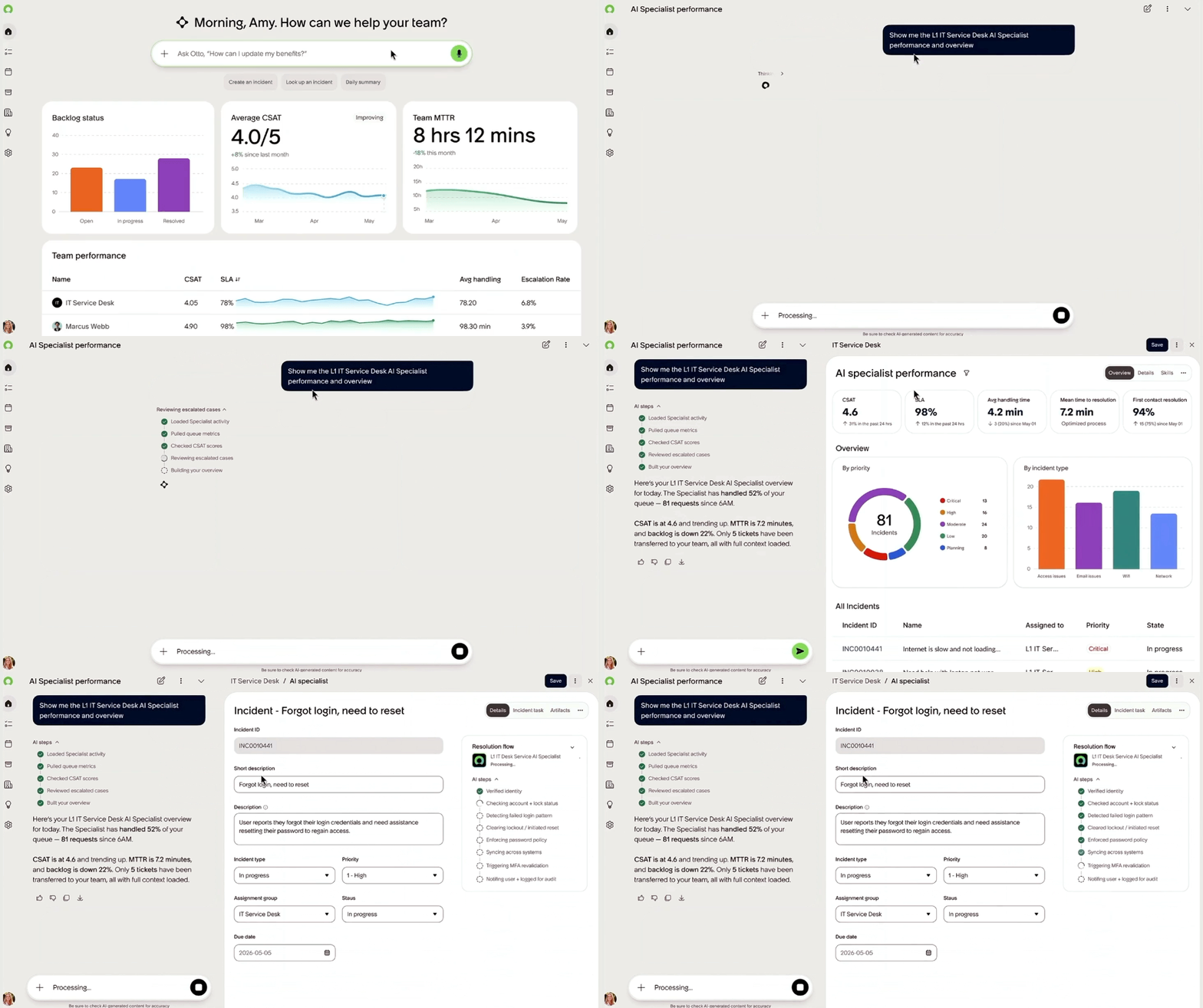
The problem nobody owned
Customers bought more than one of our applications, and they paid for it in swivel-chairing: piecing together one workflow across separately hosted apps before moving on to the next.
This disjointed pattern was familiar. In the tools we built for developers and admins, separate teams shipped separate builders with separate vocabularies, making it an non-cohesive jarring way to do work. In Workspaces, the target users were different, but the pattern was still the same.
Interoperability was the first answer (how I got it funded). It made workflows portable, so the best experience could show up inside the workspace someone already used. It solved distribution. What it didn't solve, however, was coherence: workflows designed by separate business units now sat side-by-side, and their conflicting interaction models were suddenly visible.
And users still had to find their way through. Every workspace shipped its own opinionated home, tuned for specific personas and customized by admins. Users couldn't personalize any of them, and admins were backlogging personalization requests by an average of six months.
Those homes were good at their jobs, and they guaranteed fragmentation. Our navigation shipped our org chart.
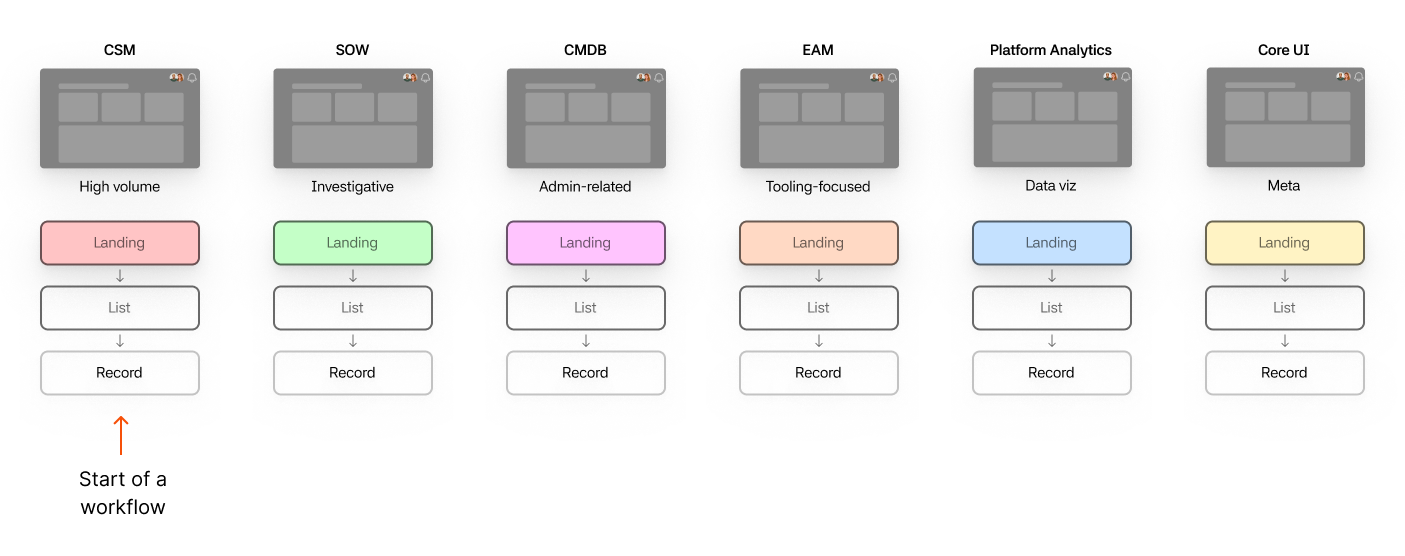
What I saw
Adoption wasn't a shared truth
Before arguing for a new home, I needed to know what "adopted" meant. It meant something different in every business unit. Each used its own transaction definitions and thresholds, so performance couldn't be compared and strategy debates stayed opinions.
I partnered with our central analytics team to define what counted as a meaningful transaction, reconcile thresholds across business units, and track month-over-month behavior for new and existing customers separately. This gave insight to who was adopting Workspaces versus who remained on our Core UI. When we mapped this data against product adoption funnels, a critical insight emerged: the true barriers to adoption weren't missing features, but implementation hurdles.
This data transformed our platform investment strategy. We proved that adoption could be unlocked by reducing configuration complexity for admins and improving interoperability for end users. Ultimately, this foundational research provided the data-backed justification needed to pursue a unified home.
AI changed what was possible
AI didn't change what customers wanted. It changed what was possible.
Conversation was the one AI pattern everyone recognized, and it quietly flips traditional SaaS: it shortcuts wayfinding, discloses progressively, and lets users reshape the output and ask for reasoning at any point.
What if a platform home borrowed those rules, sitting as an abstraction layer above application homes and personalizing to a user's role and history through telemetry and the knowledge graph?
Four places AI could sit
I worked through 4 positions for AI in the home:
- AI as a filter: Narrow what existing homes already show. It's the cheapest option, and it left every application boundary intact, just better sorted.
- AI as a destination: Make the home the place work starts, with AI reasoning surfacing tasks from across products.
- AI as a conversation: The obvious bet, since everyone recognized it. It couldn't be the whole home: people still depended on acting on surfaced work when they log on, and still needed access to list and forms. Conversation became one surface beside UI-first ones, not a replacement for them.
- AI as an action layer: Let people act on a single record, a group of related records, or a set AI had prioritized. This is what made the home more than just a smarter dashboard.
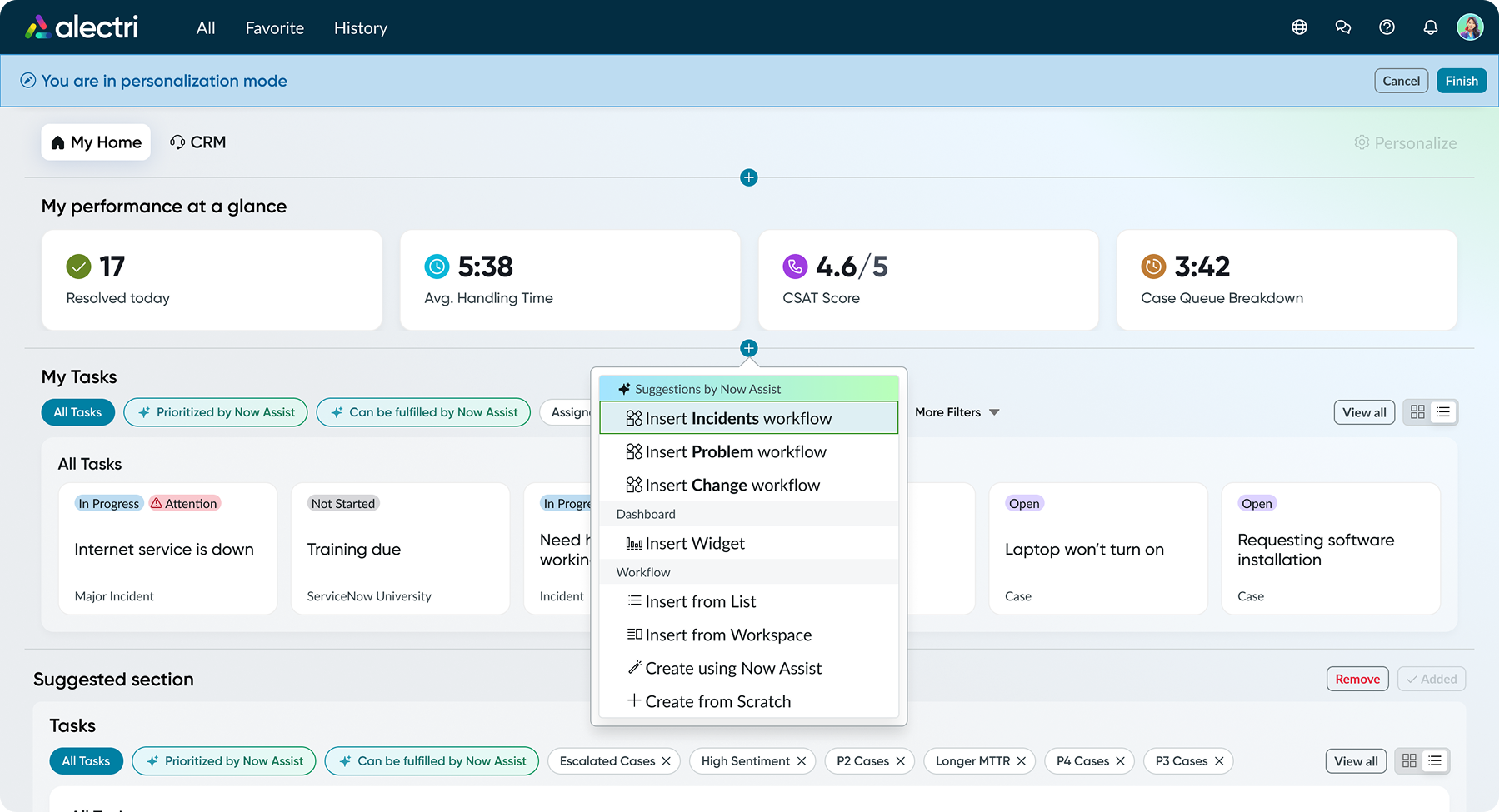 Initial concept of the new home with AI as a filter
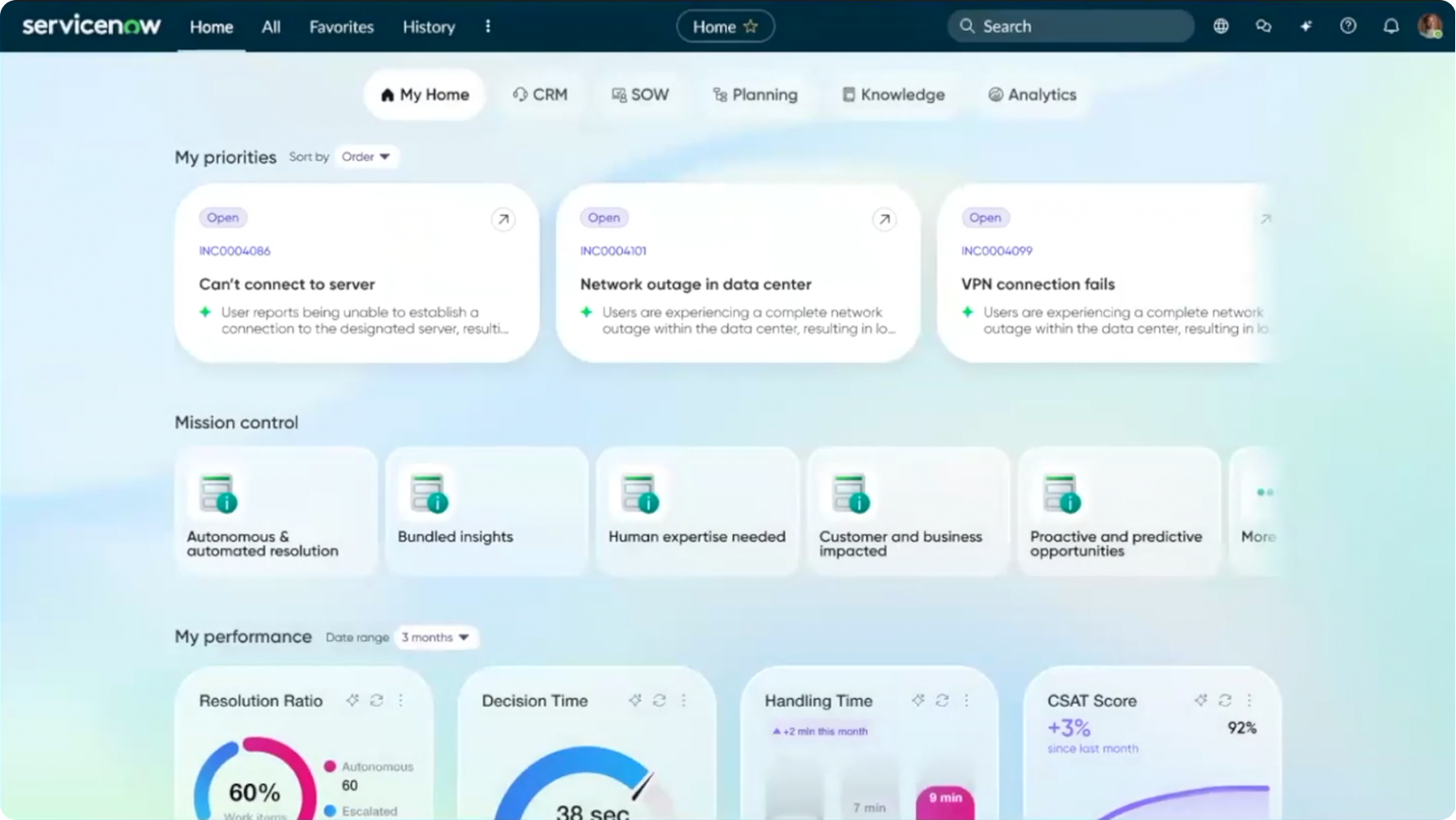 Iterative concept of the new home with AI as a destination
Five principles
That became five principles, and each one shaped the design:
- Personalization-first. The user shapes the home, not only the admin, so personalization is no longer a request sitting in an admin's queue.
- Outcome-focused. I partnered with product management on an anatomy of a workflow (trigger, intake, processing, approval, fulfillment, reconciliation), so we designed patterns around events, not features around screens.
- Human in the loop. Flattening the platform was the easy part. Automated workflows need accountability, so the action layer meant a human-in-the-loop system had to be built net-new: the system proposes a situation with suggested actions, a person accepts or rejects.
- Trust and safety. Field signal from early AI deployments showed confident recommendations that were hallucinating, inference that cost more than doing the task by hand, and unreliable behavior on messy data. Trust became the foundation, with calibrated confidence and review moments designed into the experience.
- Omnichannel. I studied how conversation coexists with pages in workplace chat tools and explored adaptive form factors down to the watch, so the home wasn't tied to one screen.
Who I pulled in
Sponsorship was sequenced.
I turned the grassroots effort into a program: frequent in-person workshops that brought together teams from three groups, with me directing resources toward the gaps we found:
- Core platform experience team, with VP-level sponsors kept close.
- Business unit teams from IT, Customer, and Employee Workflows, stress-testing against the proposed patterns.
- Admin and Builder teams who owned enablement and configuration.
The workshops ran in rounds. First, I co-hosted an agentic AI experiences workshop with the AI patterns team, using 25 hand-picked use cases across five business units. For the first time, BU teams tested their patterns against a shared, normalized set.
Then I gave business units a simplified demo to draft their own visions from. It didn't carry the philosophy. Teams invented interaction models that worked against the home's principles. So I brought five BU teams into one room with their visions and research, shared the platform vision, handed them templates to orchestrate their top use cases against it, and turned the deltas into the next iteration.
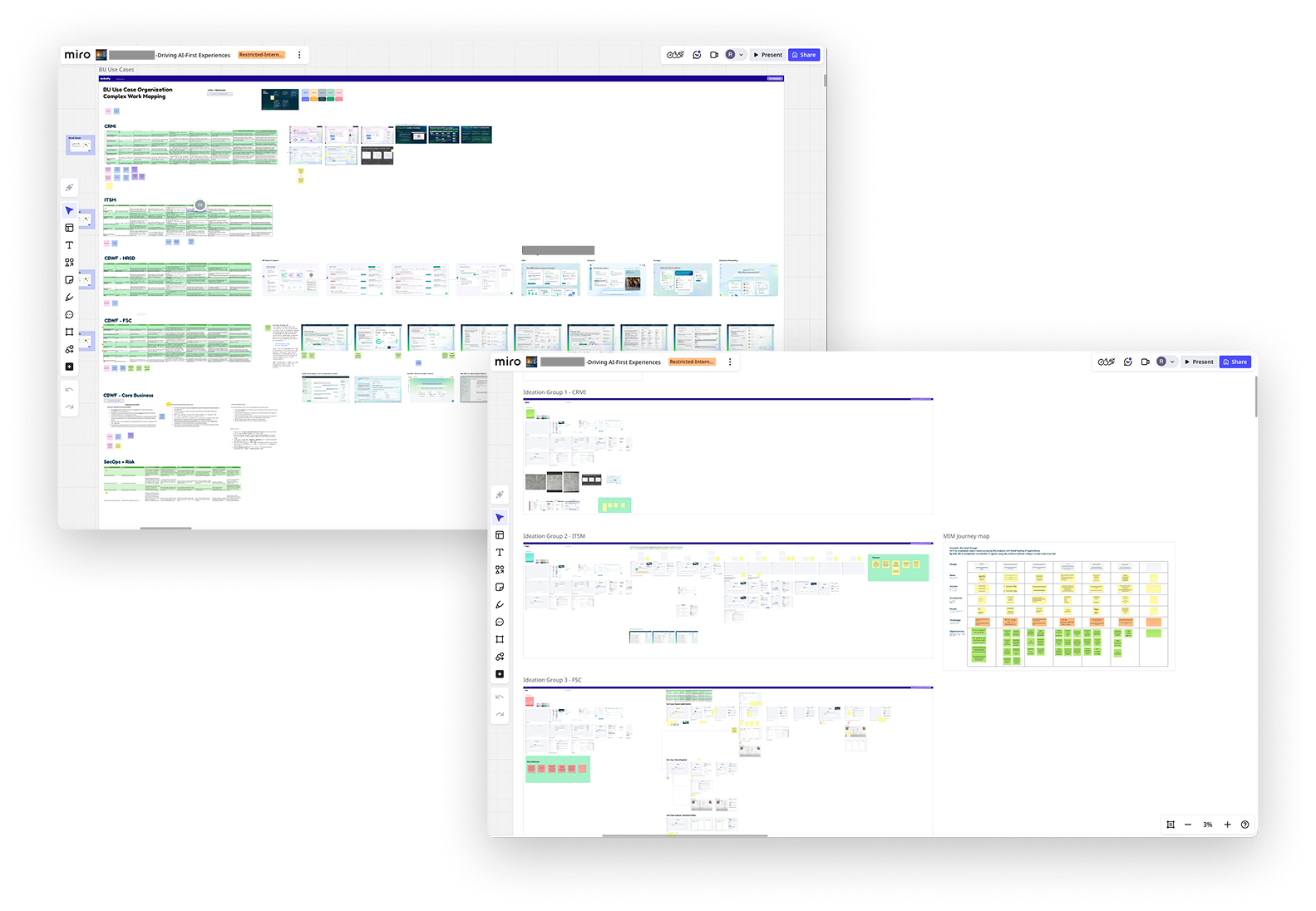 Stress-testing BU workflows across the board
The executive path climbed the same way. The first version went to a design leadership review as problem and solution. That earned the signal to keep going. For a leadership offsite, the framing rose with the altitude: less about the solution, more about reach across integrations, the design system, and BU unification. That's where our VP became the sponsor. From there, I sharpened the narrative with product leadership and built the prototype that design and product leaders carried to the CPO and BU general managers.
I originated the vision, authored the concepts, and facilitated the workshops. The rooms I wasn't in belonged to the sponsors who carried it there.
What changed
The timing lined up: customers often replaced their platform home, AI work was getting engineering priority, and the interoperability evidence showed that a unified experience needed more.
- Originated an AI-native platform direction that grew from a personalized home into a full package: home, records, navigation, notifications, and an assistant front and center.
- Turned a grassroots pitch into the company's top strategic initiative for 2026, sponsored by the CDO, the CPO, and the general managers of five business units.
- Built a shared adoption model across business units that tied each platform investment to the barrier it removed.
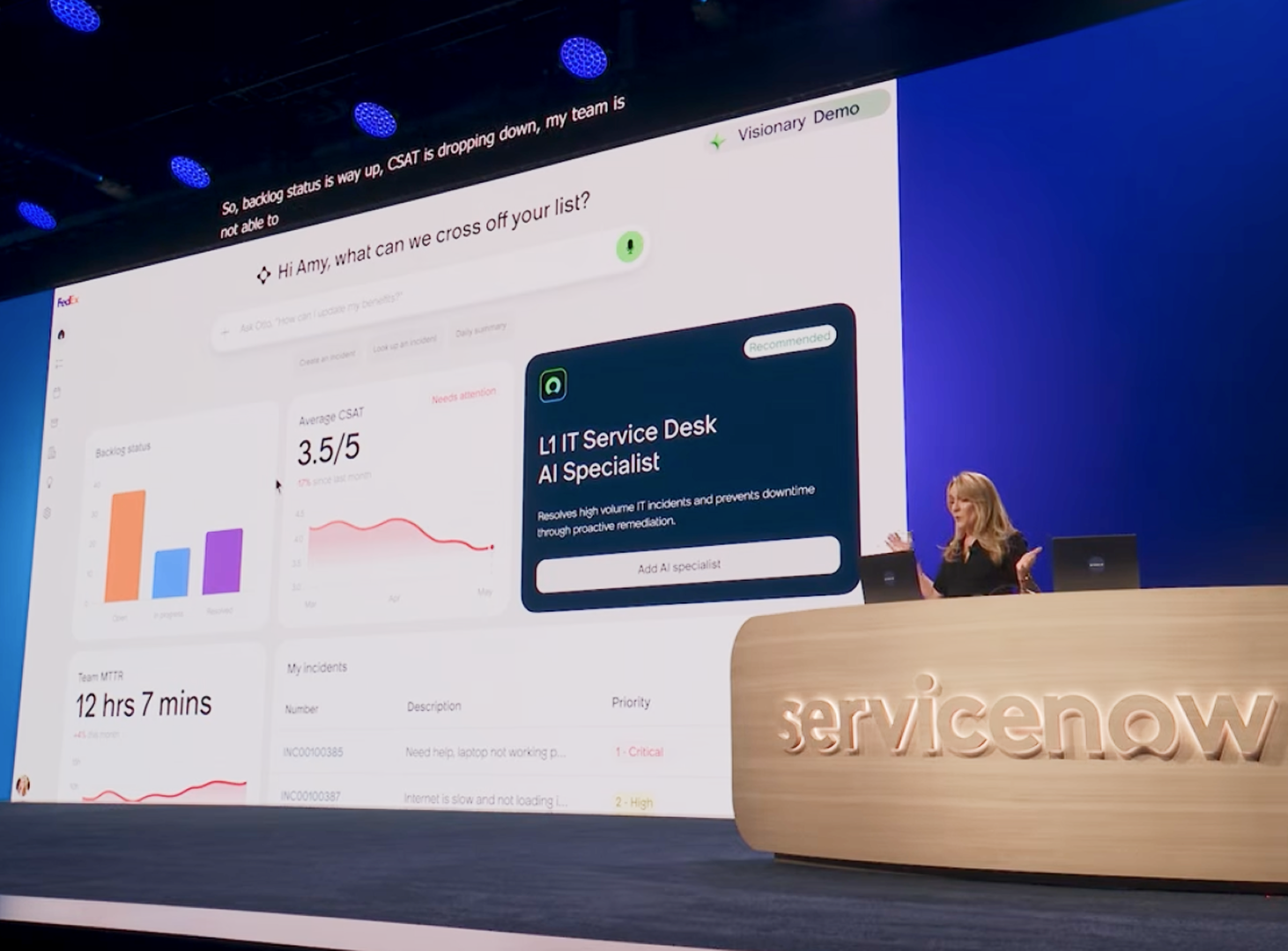
What approval didn't prove
The approval validated a desired direction, not a product. Four things were still open:
- Would the principles survive implementation? The BU visions had already shown that a demo couldn't carry them. Shipped patterns and reference implementations would have to.
- Whether a net-new human-in-the-loop system would hold under real agent behavior. This was also a pioneered test of how well our AI was ready to work.
- Whether our use cases reflected user need. I'd used AI to generate 400 use cases from business units' committed agent roadmaps to get past a bandwidth bottleneck. They showed what teams planned to build, which isn't the same as what users needed. I caught this misalignment and pivoted our approach before those assumptions became load-bearing.
- Whether any of it would move adoption. We finally had a shared way to measure. There was nothing to measure yet.
Approval turned the vision into a deadline. Within the next few days, we had ten weeks to prove it through AI Control Tower, on a framework still being defined. Part 2 - Execution →
What I'd tell a leader
- Trust is a foundation, not a feature: Relegating trust and safety to secondary menus or progressive disclosure is insufficient. It must be woven intrinsically into the core user experience. Without ambient, built-in safety, the rest of the product ecosystem fails to gain user confidence.
- AI accelerates the "job to be done": The fundamental goals of the user remain unchanged. AI does not replace the core user need; it simply acts as a powerful catalyst to help users achieve their desired outcomes faster and with less friction.
- The Inverted UX Hierarchy: AI-native platforms fundamentally flip traditional user expectations. Rather than starting with blank slates, users now anticipate proactive personalization out of the box, followed by intuitive customization, reserving complex configuration strictly as a last resort.
- Standardize adoption to align strategy: Before debating future investments, establish a unified, cross-functional definition of user adoption. When teams measure success differently, strategic decisions devolve into subjective opinions. However, this standardized metric must be paired with a holistic understanding of existing individual product strategies to ensure the overarching platform vision remains cohesive.
- Tangible patterns beat vision demos: High-level conceptual demos are insufficient for aligning execution. If left without concrete guidance, disconnected teams will inevitably fill the gaps with inconsistent solutions. To ensure core principles are actually applied, it is critical to ship reusable interaction and design patterns early.